
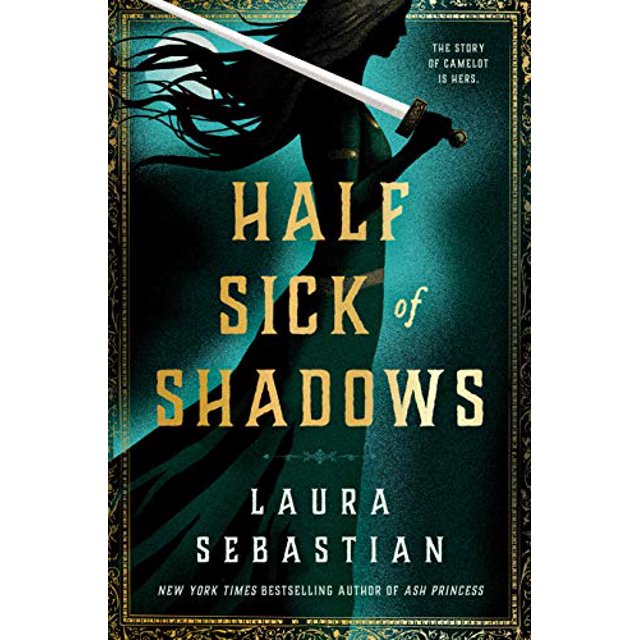
Lily maid, Elaine Asholot, the Lady of Shallot: she goes by many names, but her friends simply call her El. At least they do in Laura Sebastian’s novel “Half Sick of Shadows.” Titled after a line from Tennyson’s famous poem on the character of Arthurian legend, the book does not stick faithfully to the poem itself. It doesn’t even strictly adhere to Arthurian mythos in general—at least not on all points. But that is all for the better, at least to this reader. If she had, then Sebastian would have simply repeated the same story in the same order that we all know. It would have been dry rather than the vivid tale she weaves instead. It does follow the story of the Lady of Shalott, the lover and wife of Lancelot—most famous for drowning herself. But this tale is slightly different.
One of the most wonderful aspects of this novel is that we as readers experience time in the same way Elaine herself does. Past, present, and future intertwine in every chapter. So, it all seems to be happening at once. There is really no beginning, middle or end: no first, then, and finally, like in a linear timeline. Elaine’s childhood in Camelot, her time on Avalon, as well as the present are all stitched together like someone took the three fabrics, cut them to pieces, then wove them into one picture. It’s fairly obvious what parts belong where, to the past, present or future, but it’s all mixed up together into something new. Even their inevitable fate –the future that each is trying to avoid and outrun—is presented as “now” in terms of the story thanks to handy (and beautiful) descriptions of El’s visions.
Everyone –or nearly everyone– who picks up this book knows how the story goes: they’re aware of what happens to Arthur and everyone else, but it doesn’t happen the way readers think it will. The first instance of this occurs when the quartet arrive in Camelot –and immediately have to halt Mordred’s coronation ceremony. And that is only the beginning. From Gwen dumping Arthur, to werewolves, and binding magic, along with a surprise twist when Aruthur finally attempts to pull the sword from the stone; it’s the same old story in an entirely new and exhilarating light.
One of the most striking alterations is to the character of Merlin. Most know him as the powerful but kindly old father figure to Arthur: serving, guiding, and protecting him along the way. He helps the once and future king fulfill his destiny with his magic and advice. However, this Merlin seems more like a roadblock than help to Arthur. He contests his legitimacy, sets him three tasks to prove himself, and all around doesn’t seem to want Arthur on Camelot’s throne. As Merlin is one of my favorite characters in the legend, I have to admit I was a little sad and disappointed at this characterization. But I admired it, too. It’s interesting, against the grain, and overall feels real enough to smack of truth. It’s also brilliant in that by shedding this light on Merlin, Sebastian makes his battle with Nimue more closely mirror the ongoing contest between paganism and Christianity at the time.
Of course, there are some things that are exactly as expected: such as the constraints on women accurate to the time period. Fittingly, all references to it come from Gwen, Morgana, and Elaine. After all, even today it seems most men fail to see or acknowledge the constraints women previously and still operate under. I adored this streak of feminism and think it’s not outside the realm of possibility. As restrained as women were even in the Middle Ages, they grasped for agency, power, and some, such as Hildegard von Biggen and Christine de Pizan, attained it. This shows that women even then not only recognized the growing restraints placed on them, but also attempted to overthrow them and succeed. Unfortunately, the girl’s attempt doesn’t go as well. The three women vow to change Camelot for their sisters, and though it ultimately doesn’t succeed, the desire to—the attempt—is what matters. The narrative makes clear how much more freedom they have on Avalon, reflecting the historical reality once more as women generally had more opportunities outside of Christian European constraints.
Arthurian myth is all about fate: how destiny can’t be outrun, try as we might, and Sebastian maintains this theme throughout the novel. Of course no matter what Elaine does to change her fate, it backfires on her. Every move she makes away from it only ends up pushing her–her friends, and all of Camelot with them–closer to the precipice. She has choice, but each decision Elaine makes seems to take her down the predestined path. In fact, it seems to be the case no matter what she chooses. Several times in the novel, she looks to the future and always sees a variety of outcomes. Each variation is slightly different: an alternative possibility, such as her leaving Lancelot or the other way around, or the multiple ways his and Gwen’s affair is discovered–but each time the result is the same. She may go left or right, but either way takes her to the same place. Thus, it maintains the unique blend of agency and destiny inherent to Arthurian myth–and in a brilliantly captivating way.
However, one of the elements I liked the most about this book is that Elaine wins in the end. She finds a way to save the situation as best she can. There is nothing she can do for Arthur or Lancelot ultimately, but she manages to save them and herself pain, all while simultaneously saving Gwen and Morgana from immortal villainy. El manages to avoid the worst of the worst outcomes, and in the process, provides a sort of saving or redemption for them all, as much as she can at least with the date of Arthur’s death as well as the events that lead up to it still firmly set. They are broken in the end, yes: but not destroyed. All roads lead to the same destination; she just found the best path.
I thoroughly enjoyed this masterpiece of a novel. One of the most interesting facets of it is that time isn’t presented as linear, but as happening all at once, essentially. Everyone knows the basics of King Arthur’s story. This book stays true to it while providing some interesting twists that will keep audiences fascinated. It’s the story we know, but not, at the same time and that is nothing less than thrilling. One of the most notable alterations is the character of Merlin. This is far from the Emrys we know and love; however that is what makes it even more compelling, ultimately. Not everything in the novel is unexpected, such as the oppression women face and the theme of predestination and fate that is inherent to Arthur’s story. However, one of the things I loved most is the subtle nuance that while the big things can’t be changed, the little things can be. It is not that no one has a choice, but that all choices send them hurtling in the same direction. The only thing they can do is pick out the smoothest track, which Elaine manages to do (albeit with a few slip ups along the way). Most importantly, in the process El manages to win a kind of victory for them all, ending this otherwise doomed narrative with a shade of hope.
 Brainfullofbooks
Leave a comment