
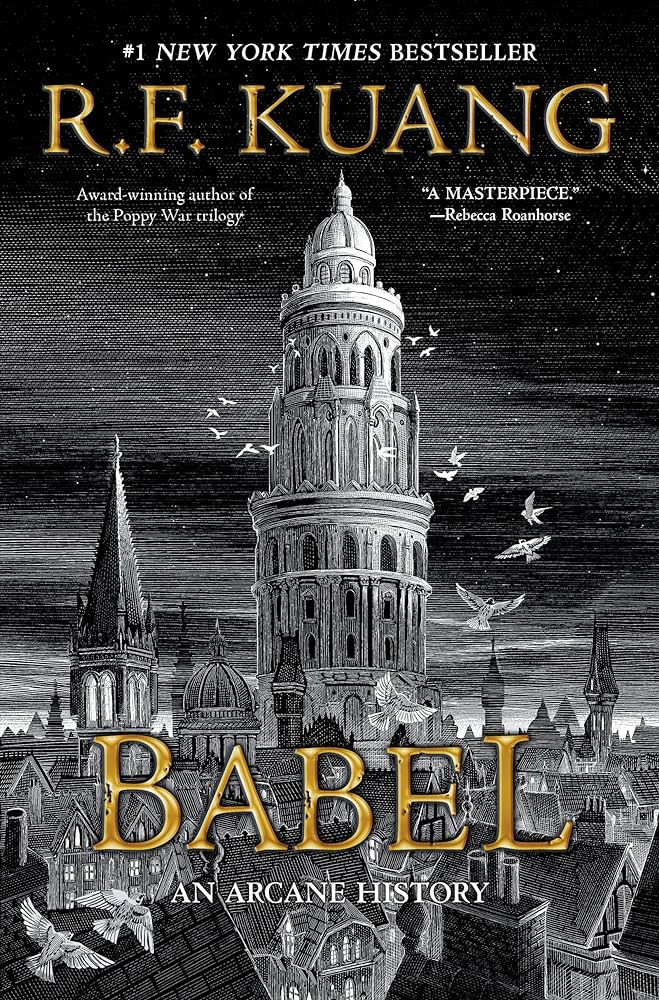
Babel begins in a house filled with corpses, and there’s about to be one more. Cholera is sweeping through Canton and Robin Swift is slowly dying on the floor of his room after watching his mother’s last breaths. Just as he’s about to follow her, there’s a glint of silver. He’s saved thanks to the power of silver and translation. His Savior, Richard Lovell, whisks him away to England marking his entire fortune change. He was brought up in a manor house, and drilled in languages by tutors all day every day—all for the goal of one day attending Babel, Oxford’s esteemed institute of translation. Eventually all his hard work pays off. He’s finally granted access to that coveted ivory tower and things couldn’t be better. He makes friends and begins to thrive in school; but not all is as it seems in Babel—and little by little the beautiful façade begins to wear away, making Robin doubt his place in the institute and England itself.
While Babel certainly contains other themes and ideas none are so prominent as the Asian representation; in fact, the story begins in Canton, China. The opium war between China and England is the crux of the book if not the main driving focus. Babel follows Robin Swift as he’s uprooted to England from China and battles to come to terms with his culture and heritage while maintaining this new English identity forced on him. Readers don’t know his real name; a Chinese name his mother and relations all called him. Not even five pages into the novel he’s forced to leave that identity behind and pick a new “English” name, the one which is used throughout the rest of the book. A large portion of the novel translates and defines Chinese characters. Robin references them multiple times through the book and all the Chinese words are actually written/translated into their pictographic language. Chinese, history, language, and culture is the backbone of this book.
Though that representation feeds into the second major theme of the book: imperialism. Babel is set when the British empire was at its height and colonization was the watchword of the world. This book sees them come head-to-head with colonialism; particularly the evils of their aims toward the Chinese takes the spotlight. That is not the only example Kuang highlights. The other characters in the book are an East Indian man, and a black woman; through these characters Babel also highlights the horrors visited on other colonies. Most of the novel is dominated by Robin’s voice but in a stroke of brilliance Kuang included one chapter for each of the other characters. One by one they’re all exposed to the evil face of Britain as they experience racism and see the mechanism of empire at work for themselves. What’s more, when they begin to comprehend their own place in this awful machine–which was more important than they could have dreamed –they begin to fight back.
When readers open the book, they will notice one unusual feature for a novel: citations. Some might think they don’t fit but given that most of Babel takes place in an academic setting–Oxford’s grounds and the illustrious translation institute–I think it’s fitting. The citations give it an academic air which only makes sense if it was written by a scholar (which Kuang certainly is, with four degrees to her name when she’s barely thirty, and as she wants us to think it was.) What’s more, it doesn’t really detract from the book: for those who are bothered by them, they’re easy to skim over. Though I would recommend reading them since they add so much to the book. They include enchanting tidbits of world building, actual interesting historical notes and even character development–or extra bits of scene and dialogue readers would miss without it. All in all, I was blown away by Kuang’ s brilliance. I’m definitely going to have to add the Poppy War Trilogy to my to read list.
 Brainfullofbooks
Leave a comment